

These white cheddar rosemary dinner rolls are soft, pillowy yeast rolls made with bread flour, whole milk, butter, and eggs, with 2 cups of sharp white cheddar and fresh minced rosemary kneaded in. The dough passes the windowpane test, rises twice (about 45 minutes, then 30 to 45 minutes), and bakes at 350°F for 20 to 25 minutes in a 9×13 pan until deep golden brown. Brush with melted butter, add flaky sea salt, and you have 12 pull apart rolls in about 2 hours 25 minutes, with an easy overnight make ahead option.
I am going to tell you how to make some buttery, white cheddar, rosemary dinner rolls. If you are looking for the ultimate side to pair with Sunday dinner or a holiday feast, you have found it.
Table of Contents
Why You Will Love These Cheddar Rosemary Dinner Rolls
- That Pull Apart Texture: Thanks to a deeply enriched dough and the magic of the windowpane test, these rolls are like soft, pillowy, and cheesy clouds.
- The Perfect Flavor Combo: Sharp white cheddar means you get incredible savory flavor without any weird orange specks throughout your dough, and the fresh rosemary gives them a lovely and cozy aroma.
- They Go With Everything: I love serving these alongside a delicious roasted chicken with butter and tarragon (the kids will go crazy for it!), but honestly, they pair beautifully with basically anything.
If a cozy roasted chicken dinner is on your menu, my Skillet Roasted Chicken and Potatoes is a great one to serve with these rolls.
What You Will Need
Special Equipment
- Stand mixer fitted with a whisk attachment and a dough hook (a hand mixer with dough hooks will work, but requires extra hand kneading)
- 9×13 inch baking dish
- Kitchen scale (highly recommended for measuring flour and cheese!)
- Pastry brush (for the egg wash and butter topping)
- Cheese grater
- Instant read thermometer (to check the milk temperature and that the rolls are done)
The Ingredients for the Yeast Mixture
- 1 cup warm whole milk (105 degrees Fahrenheit to 115 degrees Fahrenheit. Do not exceed 115 degrees Fahrenheit or it will kill the yeast!)
- 1 packet active dry yeast (2 and 1/4 tsp or 7g)
- 1/4 tsp granulated sugar
The Ingredients for the Dough
- 1/4 cup granulated sugar (50g)
- 1/2 cup unsalted butter, melted and slightly cooled (113g)
- 2 large eggs, room temperature
- 2 cups bread flour (240g) for the first addition
- 1 tsp salt
- 2 and 3/4 cups bread flour (330g) for the second addition
The Ingredients for the Mix Ins
- 2 cups sharp white cheddar cheese, freshly grated (226g)
- 2 tbsp fresh rosemary, finely minced (stems removed)
- A splash of oil (for greasing the bowl)
The Ingredients for the Topping
- 1 large egg, lightly beaten (for egg wash)
- 2 to 3 tbsp unsalted butter, melted (for brushing after baking)
- Flaky sea salt (for garnish)
- A pinch of extra minced rosemary (for garnish)
Let Us Get Baking
1. Waking Up the Yeast
First off, you need to give your yeast a little welcome home so they can wake up with a smile! In the bowl of your stand mixer, add your warm whole milk and a little pinch of 1/4 teaspoon of sugar, then sprinkle your packet of active dry yeast on top. Give it a whisk and set it aside for 5 to 10 minutes until nice and foamy.
Pro Tip! Your milk should be warm (between 105 and 115 degrees Fahrenheit). Check it with a thermometer, because if it is too hot, it will kill the yeast! After a few minutes, the mixture should be nice and foamy. If it is not foaming up, toss it out and start over. Your yeast might have expired or are not active enough anymore, and your dough just will not rise.
2. A Little Bit of Prep Work
While the yeast wakes up, prep your mix ins. Grate your sharp white cheddar. To be honest, you could use any cheddar you like, but the white cheddar just looks so beautiful in the final roll.
Next, mince up your fresh rosemary. Pull the leaves off the stem. You do not want to chop up the stem because it is too woody and the flavor just is not there. Give the leaves a really nice and fine mince so you have tiny little pieces of rosemary throughout, not big giant pieces that you are chewing on. If you are not a fan of rosemary, you can absolutely omit it. They will still be delicious and cheesy dinner rolls!
3. Mixing the Dough
Now for some of the fun stuff! Into your foamy yeast mixture, add your 1/4 cup of sugar, 1/2 cup of unsalted melted butter (because butter makes everything better), and 2 room temperature eggs. Make sure the butter is only warm, not hot, so it does not harm the yeast. Crack the eggs right into the bowl, just check for shells first. You definitely do not want a crunchy moment here! Whisk until well combined.
4. Incorporate the First Batch of Flour
Next, whisk in your first addition of 2 cups of bread flour and 1 teaspoon of salt for contrast. Do this first part by hand with a hand whisk until you have a smooth and buttery batter. It usually takes your mixer a good deal of time to work that initial bit of flour into a buttery milk mixture, so doing it by hand just speeds things along.
5. Gradually Add the Remaining Flour
Now grab your mixer with a dough hook to add the rest of the flour. You actually want to have your mixer on the lowest setting and add the remaining 2 and 3/4 cups of bread flour in slowly. Do a heaping spoonful (about a quarter cup) at a time, allowing each addition to mostly incorporate before adding the next. It is exactly like making a meringue where you slowly add sugar into egg whites. You want to take your time so the flour can dissolve into a lovely matrix of yeast, butter, and milk.
Love working with yeast dough? My Easy Amazing Cinnamon Rolls are another soft, pillowy yeast bake that uses a similar enriched dough approach.
6. Kneading and the Windowpane Test
Once all the flour is added, let the mixer run for about 12 minutes. Because this is a highly enriched dough, it is going to look a little sticky and messy at first. If you pull it apart early on, it will have no structure and just break.
Once the mixer has done its job, transfer the tacky and stretchy dough to a clean counter. Knead it by hand for a few minutes. You will know the dough is ready when it passes the stretch test (also known as the windowpane test). If you take a little piece of dough and stretch it out, it should not break right away. You should be able to stretch it so thin that you can actually see light coming through it!
7. Adding the Cheese and Rosemary
If you just wanted a boring, old, delicious buttery dinner roll, your dough is ready to rise. But we are adding cheddar and rosemary! Pop the dough back into the mixer, add the freshly grated white cheddar, and sprinkle in the minced rosemary so it gets perfectly distributed. Mix on low just until well distributed. Knead it a couple of times by hand just to make sure there is not a giant clump of cheese hiding out somewhere!
8. First Rise
Place the dough into a large and lightly oiled bowl. Turn it once to coat, cover loosely with a damp towel or plastic wrap, and let it rise in a warm and cozy place for about 45 minutes, or until doubled in size.
9. Shaping the Rolls
Once the dough has doubled, it is time to shape! Gently punch down the dough and turn it out onto a clean and un floured surface. Divide the dough into quarters, and divide each quarter into three equal pieces (a little math lesson in baking: 4 times 3 is 12!).
To shape them, gather the corners of each piece, pinch them together, and use your thumb and middle finger to roll the dough into smooth and tight balls in small circular motions against the counter. If you have flour on the counter, the rolls will just slide around. They need contact with the counter to get that beautiful tight shape!
10. Second Rise
Pop the shaped rolls into a buttered 9×13 inch baking dish, cover loosely, and let them rise again for 30 to 45 minutes until they are puffed up and almost doubled in size. While they rise, preheat your oven to 350 degrees Fahrenheit (175 degrees Celsius).
11. Egg Wash and Bake
Brush the tops of the puffed rolls with a lightly beaten egg for a shiny and golden brown finish. Bake for 20 to 25 minutes until deep golden brown. The center of a roll should read about 190 degrees Fahrenheit on an instant read thermometer, so they are baked all the way through.
12. Garnish and Serve!
Immediately after taking them out of the oven, liberally brush the rolls with more melted butter and finish with a sprinkle of fresh minced rosemary and flaked sea salt. Let them cool for 10 minutes before pulling apart, and then just look at that pull apart action! It is like a cheesy and rosemary pillow. I hope you get a chance to make these and enjoy!
What to Serve With These Dinner Rolls
- Holiday feasts: pair them with my Juicy Brined and Stuffed Turkey, plus my Easiest Turkey Drippings Gravy and Easy 4-Ingredient Cranberry Orange Sauce
- Cozy soups: dunk them into my Easy Butternut Squash Soup
- Hearty stews: serve them with my Best Beef Stew for a Sunday dinner
- Presentation tip: pile them warm into a cloth lined basket, brush with butter, and finish with flaky salt and a pinch of fresh rosemary
- Extra butter on the side for spreading
Storing, Freezing, and Reheating Dinner Rolls
- Store cooled rolls in an airtight container or zip top bag at room temperature for up to 2 days
- If your kitchen is warm or humid, keep them in the refrigerator instead, and warm them before serving to soften them back up
- For longer storage, freeze fully cooled baked rolls in a freezer bag for up to 3 months
- Thaw at room temperature, then warm in the oven or the microwave for a few seconds until soft and buttery again
If you like this recipe Explore more recipes
FAQs
Can I make white cheddar rosemary dinner rolls ahead of time?
Yes, absolutely! Once you have shaped the dough into balls and placed them into your baking dish, cover the dish tightly and pop it in the refrigerator overnight (up to 16 hours). The next day, just bring the rolls out to the counter for 1 to 2 hours so they can come to room temperature and finish their second rise before you egg wash and bake them! Do not let the dough sit out for much longer than 2 hours.
Why did my dinner rolls not rise?
There are a couple of usual suspects here! The most common is that your milk was too hot. Anything above 115 degrees Fahrenheit will kill the yeast on contact. It could also be that your yeast is expired, which is why we always proof it first to see if it foams. Finally, yeast loves a cozy environment, so if your kitchen is super drafty or cold, it might just need more time or a warmer spot to rise!
What type of cheddar cheese works best for these?
A nice sharp or extra sharp white cheddar is going to give you the absolute best flavor. But here is the most important part: always use block cheese and grate it yourself! Bagged and pre shredded cheese is tossed in starches to keep it from clumping, which stops it from melting smoothly and can actually make your roll dough too dry.
Can I use dried rosemary instead of fresh?
You can, but you have to adjust the ratio! Dried herbs are much more concentrated and potent than fresh ones. If you are swapping them out, use 1 teaspoon of dried rosemary for every 1 tablespoon of fresh rosemary called for in the recipe. So you would need about 2 teaspoons of dried rosemary total.
How do I store leftovers so they stay soft
Keep any leftover rolls in an airtight container or zip top bag at room temperature for up to 2 days. Because these rolls have cheese, milk, and eggs, put them in the fridge if your kitchen is warm, or freeze them for longer storage. Warm them up in the oven or microwave for a few seconds before serving, and they will be soft and buttery again.
Can I freeze these dinner rolls?
Yes. Let the baked rolls cool completely, then freeze them in a freezer bag for up to 3 months. Thaw them at room temperature and warm them in the oven until soft. I have not tested freezing the unbaked dough.
Can I use instant yeast instead of active dry yeast?
Instant yeast can generally be swapped for active dry yeast in equal amounts, and you can skip the foaming step.
Can I use all purpose flour instead of bread flour?
You can, but bread flour gives these rolls their soft, chewy, tall structure. All purpose flour works in a pinch and may give a slightly softer, less chewy roll. I have not tested it, so add the last bit of flour slowly and stop when the dough is tacky but not sticky.
Can I make these by hand without a stand mixer?
Yes, it just takes more effort. Whisk the first addition of flour by hand, stir in the rest with a sturdy spoon, then knead on a clean counter until the dough passes the windowpane test. Expect it to take a while longer than the mixer, and I have not tested the exact time.
Can I make flavor variations like garlic, Parmesan, or honey butter?
You can, but I have not tested these. For garlic, add a minced clove or two to the melted butter you brush on after baking. For Parmesan, swap a small amount of the cheddar for grated Parmesan. For honey butter, whisk a spoonful of honey into the melted butter topping.
Can I double this recipe for a crowd?
Stand mixers have limits, and doubling this much flour can overload the motor. Make two separate batches back to back, and bake the rolls in two 9×13 inch dishes.
What is the windowpane test?
It is a simple way to check that your dough has been kneaded enough. Take a small piece of dough and gently stretch it out thin. If it stretches so thin you can see light through it without tearing, the gluten is ready and your rolls will be soft and fluffy.
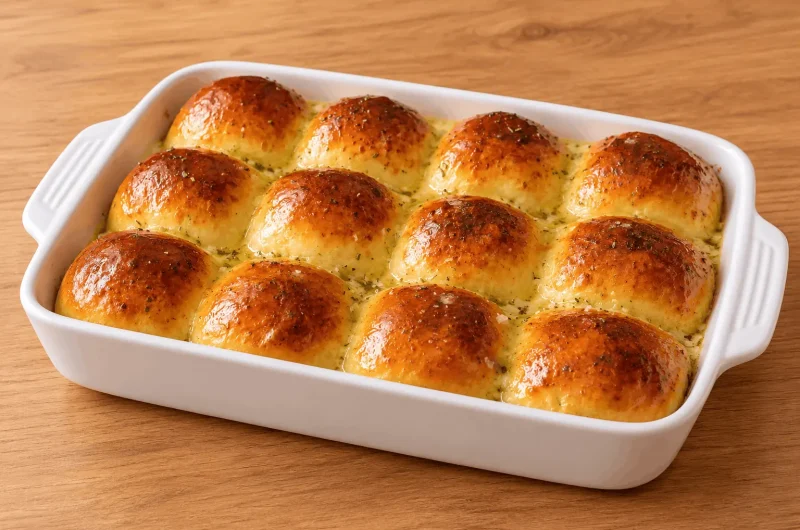
Buttery White Cheddar Rosemary Dinner Rolls
Course: SidesCuisine: AmericanDifficulty: Intermediate12
rolls30
minutes25
minutes390
kcal90
minutes2
hours25
minutesSoft, pillowy, pull-apart dinner rolls packed with sharp white cheddar and fresh rosemary, finished with a generous brush of melted butter and flaky sea salt.
Ingredients
- Equipment Needed:
Stand mixer with dough hook
9×13-inch baking dish
Kitchen scale
Pastry brush
Cheese grater
Instant-read thermometer
- Ingredients:
1 cup warm whole milk (105°F to 115°F)
1 packet active dry yeast (2 1/4 tsp / 7g)
1/4 tsp granulated sugar (for yeast)
1/4 cup granulated sugar (50g)
1/2 cup unsalted butter, melted and slightly cooled (113g)
2 large eggs, room temperature
2 cups bread flour (240g)
1 tsp salt
2 3/4 cups bread flour (330g)
2 cups sharp white cheddar cheese, freshly grated (226g)
2 tbsp fresh rosemary, finely minced
1 tbsp vegetable oil (for the bowl)
1 large egg, lightly beaten (for egg wash)
3 tbsp unsalted butter, melted (for topping)
Flaky sea salt (for garnish)
Directions
- In a stand mixer bowl, whisk the warm milk, yeast, and 1/4 tsp sugar. Let sit for 5 to 10 minutes until foamy.
- Whisk in the 1/4 cup sugar, 1/2 cup melted (warm, not hot) butter, and 2 eggs until combined.
- Add the first 2 cups (240g) of bread flour and 1 tsp salt. Whisk by hand until completely smooth.
- Switch to the dough hook attachment. On the lowest speed, slowly add the remaining 2 3/4 cups (330g) of flour, about 1/4 cup at a time.
- Mix for 12 minutes, then knead by hand for 2 to 3 minutes until the dough passes the windowpane test (stretches thin without breaking).
- Return the dough to the mixer and mix in the freshly grated cheddar and minced rosemary just until distributed.
- Place the dough in a lightly oiled bowl, cover, and let rise in a warm spot for 45 minutes or until doubled.
- Divide the dough into 12 equal pieces. Roll each piece into a tight ball on a clean, un-floured surface.
- Arrange the rolls in a buttered 9×13-inch baking dish. Cover and let rise for 30 to 45 minutes until puffed. Preheat oven to 350°F (175°C).
- Brush the rolls with the beaten egg and bake for 20 to 25 minutes until deep golden brown and about 190°F in the center.
- Immediately brush warm rolls with the remaining melted butter, then sprinkle with flaky sea salt and a pinch of minced rosemary. Let cool 10 minutes before serving.
Notes
- Watch Your Temp! Liquid heated above 115°F will kill your yeast, leaving you with dense pucks instead of fluffy rolls. Keep it between 105°F and 115°F, and make sure the melted butter is warm, not hot.
- Grate Your Own Cheese: Always use a block of cheese grated by hand. Pre-shredded bagged cheese is coated in anti-caking starches that will make your dough dry and prevent that gorgeous, gooey melt.
- Storage: Keep leftover rolls in an airtight container at room temperature for up to 2 days. If your kitchen is warm, refrigerate them and warm before serving. Freeze baked, cooled rolls for up to 3 months. Warm in the oven or microwave for a few seconds to make them soft and buttery again.
- Make Ahead: After placing the shaped dough balls into your baking dish, cover tightly and refrigerate overnight (up to 16 hours). The next day, let them sit at room temperature for 1 to 2 hours to finish their second rise before baking. Do not leave the dough out much longer than 2 hours.
- Crowd Tip: Make two separate batches instead of doubling, since doubling can overload a stand mixer.
- Allergen Note: Contains wheat (gluten), milk, and egg.