
Spaghetti carbonara is a Roman pasta dish made without cream, where rendered guanciale fat, hot starchy pasta water, egg yolks, whole eggs, and freshly grated Pecorino Romano are emulsified off the heat into a silky, glossy sauce that coats every strand. This version goes all the way and builds the pasta from scratch using the Italian Grandma Method, then finishes with a crispy pecorino pangrattato topping that will make you look like a culinary genius.
Let us make spaghetti carbonara! But we are not just throwing dried noodles into a pot. We are going all out and making fresh pasta entirely from scratch. You might be wondering, why go through so much effort making your pasta when Carbonara should be so quick and easy?
The answer is actually quite simple. When you have a recipe like Carbonara that does not have very many steps or ingredients, it is more important than ever to focus on the details.
Table of Contents
Why You Will Love This Spaghetti Carbonara Recipe
- The Ultimate Flex: Making fresh pasta from scratch using the Italian Grandma Method is a bit of a workout, but it yields a chewy and silky texture you just cannot buy in a box.
- That Liquid Gold Sauce: We are strictly using guanciale (cured pork cheek) and rendering it down low and slow. It creates a smoky and peppery foundation that makes Carbonara what it is.
- The Pangrattato Crunch: Top this dish with a crispy, pecorino-infused breadcrumb mixture. It only takes a few seconds to make, but it adds an incredible texture that will make you look like a culinary genius.
- Zero Cream Allowed: Getting that luxurious and velvety sauce entirely through the magic of eggs, starchy pasta water, and off-heat emulsification. No cream needed (or allowed)!
If you love deeply satisfying, from-scratch Italian pasta dishes, you are also going to want to try our Lentil Bolognese, a richly flavored, slow-cooked sauce that puts the same level of love and attention into every detail.
What You Will Need
Special Equipment
- Large wooden cutting board or clean work surface
- Bench scraper
- Pasta machine (manual or electric)
- Chitarra (pasta guitar) or a standard spaghetti cutter attachment
- Large skillet or pan (for the guanciale)
For the Fresh Pasta
- 300g (about 2½ cups) Tipo 00 flour or all-purpose flour, plus extra for dusting
- 2 whole eggs
- 4 egg yolks
- Splash of water (only if the dough is too dry)
- Semolina flour (for dusting the cut pasta)
For the Pangrattato (Crispy Topping)
- 2 tbsp olive oil
- ½ cup plain breadcrumbs
- 2 tbsp Pecorino Romano, freshly grated
For the Carbonara Sauce
- 150g (approx. 5 oz) guanciale, cut into thick strips or lardons (Substitute: pancetta or thick-cut bacon)
- 2 whole eggs
- 2 egg yolks
- 75g (approx. 1 cup) Pecorino Romano, freshly grated
- Plenty of freshly cracked black pepper
- Salt (for the pasta water)
- Fresh parsley, finely chopped (for garnish)
Let us Get Cooking
1. The Italian Grandma Method
Making fresh pasta starts with pouring the flour onto your cutting board. Press down in the center to make a nice well. Crack in two whole eggs, and add four additional egg yolks into the well. Keeping everything inside this well, whisk up the eggs using a fork. Pretend the flour is a bowl! Make sure not to break the edge of that bowl, or the egg is going to spill everywhere.
2. Knead the Dough
Once your egg is fully scrambled, slowly and gradually incorporate the flour from the edges. Once it is thick enough not to run, pull it all together with a bench scraper and your hands. Bring the dough together and knead vigorously for 10 minutes, pushing away with the palm of your hand and folding it back. If you are doing it right, you will probably be sweating a little bit at the end! This workout develops the gluten for that perfect chew. If it is too dry, add a tiny sprinkle of water. Knead until silky smooth. Wrap tightly in plastic wrap and let rest at room temperature for 1 to 3 hours.
3. Enter the Pasta Guitar
Cut the rested dough into 4 even pieces (keep unused pieces covered). Flatten one piece and pass it through a pasta machine on its widest setting. Fold it in half and pass it through again to remove air bubbles. Continue passing the dough through progressively thinner settings until you reach setting number 6. Dust the sheet lightly with semolina. Place the sheet on your chitarra (or run through a spaghetti attachment) and roll to cut into strands. It cuts your pasta into perfectly even, square-sided strands that hold that Carbonara sauce better than any other pasta shape! Toss the fresh spaghetti in semolina to prevent sticking.
4. Make the Pangrattato
In a small pan, heat the olive oil and breadcrumbs over low heat. Stir constantly until golden brown and crispy. Remove from the heat, stir in 2 tablespoons of grated Pecorino cheese, and transfer to a paper towel-lined baking sheet to drain.
5. Render the Guanciale
The foundation of the flavor in our authentic spaghetti carbonara comes from guanciale. Place the guanciale strips into a large, cold skillet. Turn the heat to low. We want to give this fat time to slowly melt into liquid gold, as opposed to quickly crisping up the outside and locking that fat in. Be patient! It takes about 10 minutes until the meat is crispy on the outside but tender inside, and the pan is filled with liquid fat. Turn off the heat completely.
6. Prep the Egg Mixture
The secret to the sauce is mixing two whole eggs, two egg yolks, 1 cup of grated Pecorino Romano cheese, and a lot of fresh cracked black pepper in a bowl. Whisk together.
7. Cook the Pasta
Bring a large pot of water to a rolling boil and salt it heavily. Drop the fresh pasta in and cook for just 60 seconds. Using tongs, transfer the hot pasta directly into the off-heat guanciale pan. Crucial step: Reserve a mug of the hot, starchy pasta water.
8. Build the Sauce (No Flame!)
Remember, we are not cooking with a flame anymore! Working quickly, pour the egg and cheese mixture over the pasta. Toss rapidly and vigorously. By adding splashes of hot pasta water bit by bit and mixing constantly off the heat, the eggs cook safely and the cheese melts down into a silky, consistent, beautifully thick sauce. (If it will not thicken, place it over very low heat for a few seconds, then remove immediately while stirring continuously.)
9. Garnish and Serve
Serve immediately in warm bowls. Top it off with that crispy pangrattato, a light dusting of parsley, and an extra crack of black pepper. I think my nonna would be so proud!
This carbonara is a real dinner-table showstopper. If you love Italian pasta nights, our Creamy Garlic Pasta is a quick, weeknight-friendly Italian pasta that comes together in about 20 minutes and is just as satisfying.
If you like this recipe Explore more recipes
FAQs
Does authentic spaghetti carbonara have cream in it?
Listen, adding cream to Carbonara is a big no no in Italy! Authentic spaghetti carbonara gets that beautifully creamy and silky sauce entirely from the magic of emulsifying raw eggs, freshly grated Pecorino Romano cheese, rendered pork fat, and hot, starchy pasta water. No cream is needed or allowed!
Why does my Carbonara turn into scrambled eggs?
This is the most common mistake, and it happens when your pan is too hot. To avoid scrambled eggs, you must take your pan completely off the heat before adding your egg and cheese mixture. The residual heat from your cooked pasta and a splash of hot pasta water is more than enough to cook the eggs safely and melt the cheese.
What is the difference between Guanciale, Pancetta, and Bacon?
Guanciale is the holy grail for this dish. It is cured pork cheek (jowl) and has a super rich, peppery fat that melts down into liquid gold. Pancetta is cured pork belly (unsmoked), making it the best substitute. Bacon is also pork belly, but it is typically smoked, which gives the dish a completely different flavor. A spaghetti carbonara with bacon will still be delicious, but it is not traditional!
Which cheese is best for spaghetti carbonara?
Pecorino Romano is the traditional and authentic choice. It is a sharp and salty hard cheese made from sheep milk that perfectly balances the rich pork fat. If you find Pecorino to be a little too intense, you can easily use a 50/50 blend of Pecorino and Parmigiano Reggiano for a milder flavor.
Can you reheat spaghetti carbonara?
Honestly? It is highly discouraged. Reheating Carbonara will just cook those eggs further, destroying that beautiful emulsion we worked so hard to build. You will end up with dry noodles and scrambled eggs. Carbonara is a masterpiece that is always best enjoyed fresh right out of the pan!
Can I make spaghetti carbonara without fresh pasta?
Absolutely! If you are skipping the homemade dough and using boxed dried spaghetti, simply boil the pasta until it is 1 minute shy of al dente according to the package directions (usually 8 to 10 minutes) instead of the 60 seconds required for fresh pasta. The sauce method stays exactly the same.
Love building your pasta skills? Our Spicy Honey Garlic Butter Shrimp Pasta is a great next-level pasta dish to try once you have mastered your carbonara technique, packed with bold flavor and ready in minutes.
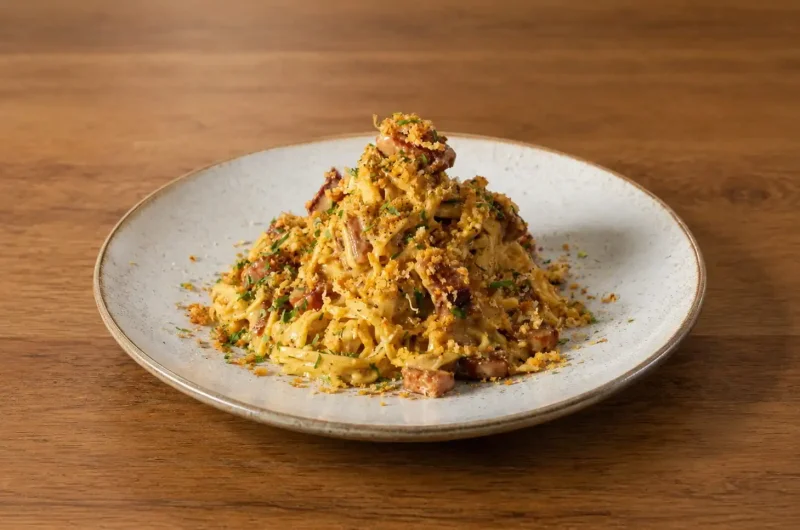
Authentic Spaghetti Carbonara Recipe with Homemade Fresh Pasta (No Cream!)
Course: Main CourseCuisine: ItalianDifficulty: Intermediate2-4
servings45
minutes15
minutes750
kcal60
minutes2
hoursAn authentic, from-scratch take on a Roman classic. Rich, peppery guanciale, perfectly chewy homemade pasta, and a velvety egg-and-cheese sauce made without a single drop of cream, topped with a crispy pecorino pangrattato crunch.
Ingredients
- Equipment Needed:
Pasta machine
Chitarra or spaghetti cutter attachment
Bench scraper
Large skillet
- Ingredients:
- For the Fresh Pasta:
300g (about 2 and 1/2 cups) Tipo 00 or all-purpose flour
2 whole eggs
4 egg yolks
Semolina flour for dusting
- For the Pangrattato:
2 tbsp (30ml) olive oil
60g (1/2 cup) plain breadcrumbs
15g (2 tbsp) Pecorino Romano, freshly grated
- For the Carbonara Sauce:
150g (5 oz) guanciale, cut into lardons
2 whole eggs
2 egg yolks
75g (1 cup) Pecorino Romano, freshly grated
Freshly cracked black pepper to taste
Salt for boiling pasta
Fresh parsley, chopped for garnish
Directions
- Pour 300g flour onto a clean surface, create a well, and add 2 whole eggs and 4 yolks.
- Whisk the eggs with a fork, gradually pulling in flour. Once a paste forms, use a bench scraper to incorporate the remaining flour.
- Knead vigorously by hand for 10 minutes until silky smooth. Wrap tightly and rest at room temperature for 1 to 3 hours.
- Cut dough into quarters. Pass through a pasta machine down to setting 6. Dust with semolina and cut into spaghetti using a chitarra or pasta cutter.
- In a small pan, toast breadcrumbs in olive oil over low heat until golden. Remove from heat, stir in grated Pecorino, and set on a paper towel.
- Place guanciale in a cold, large skillet over low heat. Cook for 10 minutes until the fat renders out and the meat is crispy. Turn off the heat completely.
- In a bowl, whisk 2 whole eggs, 2 yolks, grated Pecorino, and generous black pepper.
- Boil the fresh pasta in heavily salted water for 60 seconds. Transfer directly to the off-heat skillet. Reserve 1 cup of pasta water.
- Pour the egg mixture over the pasta. Toss vigorously and continuously, adding splashes of hot pasta water until a thick, creamy sauce forms.
- Serve immediately topped with the pangrattato, parsley, and extra pepper.
Notes
- The Golden Rule of Carbonara: Never add the egg mixture over a direct flame. Always take your pan completely off the heat first, or you will end up with scrambled eggs. The heat from the freshly boiled pasta and warm pan is enough to safely cook the eggs.
- Guanciale Swaps: If you cannot find guanciale, unsmoked pancetta is your next best option. Bacon will also work but gives a smokier, less traditional flavor.
- No Fresh Pasta: If using dried spaghetti, boil until 1 minute shy of al dente per package directions (usually 8 to 10 minutes). The sauce method stays the same.
- Food Safety: The off-heat emulsification method described here safely cooks the eggs using residual heat from the pasta and pasta water. The egg mixture is never eaten completely raw. If you are immunocompromised or cooking for young children, use pasteurized eggs.